Is your website working against you?
Most businesses invest heavily in their website and assume the job is done.
Most businesses are wrong.
Your website doesn’t just need to impress human visitors — it needs to communicate clearly with AI LLMs that are increasingly deciding what information people see in the first place.
Welcome to the AIO + AEO + GEO future.
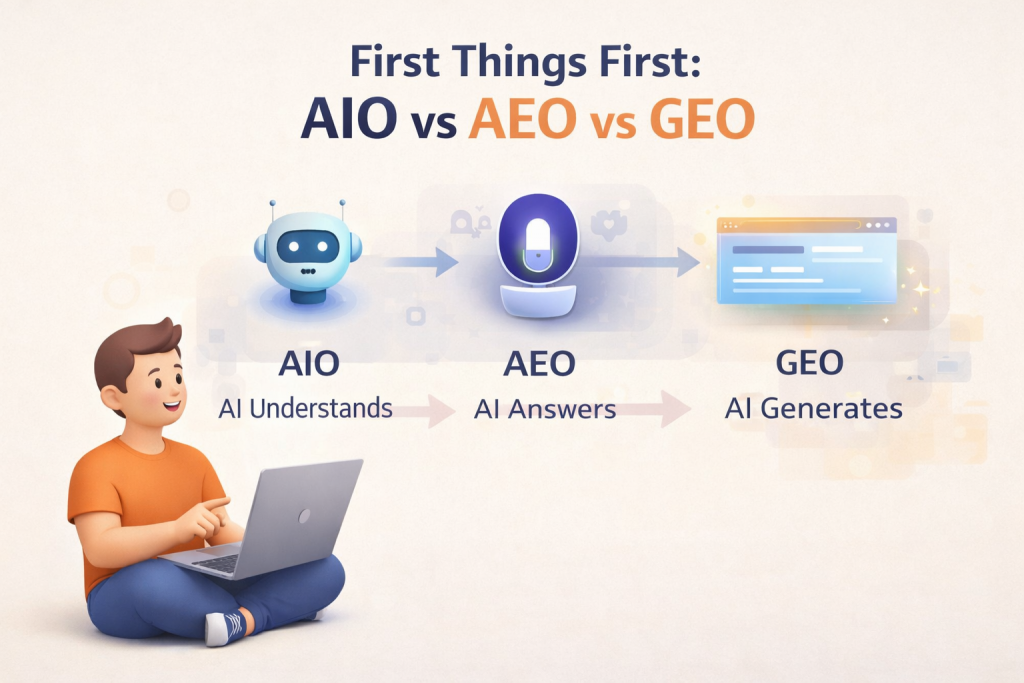
Three terms. One very important shift.
AIO (AI Optimisation) is about structuring your website so AI systems like ChatGPT, voice assistants, and AI-powered search can understand,summarise, and recommend your content to users. Think of it as making your website readable to machines that think.
AEO (Answer Engine Optimisation) is about making sure your content is the one that gets chosen as the answer. Siri. Alexa. Google’s featured snippets. They all need a source. AEO is how you become that source. If AIO is about being understood, AEO is about being picked.
GEO (Generative Engine Optimisation) goes even further. It’s not about ranking on a results page anymore. It’s about appearing inside the AI-generated answer itself, before a user even thinks to scroll.
Here’s the uncomfortable truth. Google used to send people to your website. AI now summarises your website for people. And if your content isn’t clear, structured, and authoritative enough to be cited, AI won’t mention you at all.
Traditional SEO alone is no longer enough. But AI visibility is built on those very fundamentals.
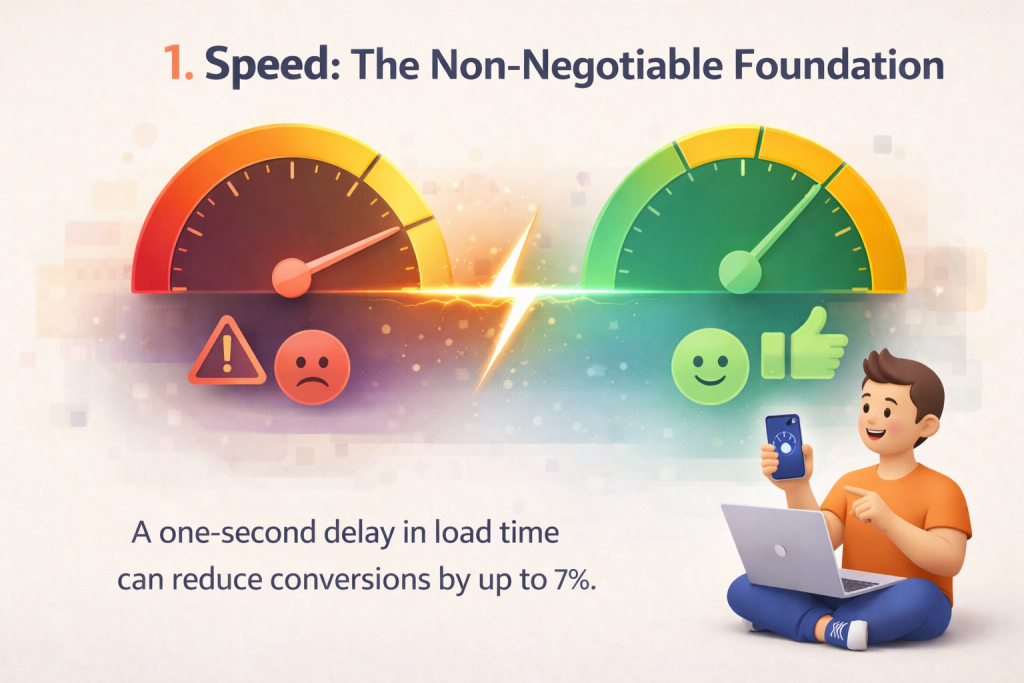
A slow website doesn’t just frustrate visitors. It silently kills your rankings, your conversions, and your credibility with AI indexing systems.
Here’s a number worth sitting with: a one-second delay in load time can reduce conversions by up to 7%.
| Do This | Avoid This |
| Optimise all images in WebP format | Heavy animations that block page rendering |
| Serve assets through a CDN | Ignoring mobile performance metrics |
| Minify CSS and JavaScript files | Loading large, uncompressed media files |
| Enable browser and server-side caching | Treating speed as an afterthought |
| Regularly audit Core Web Vitals | Assuming desktop speed = mobile speed |
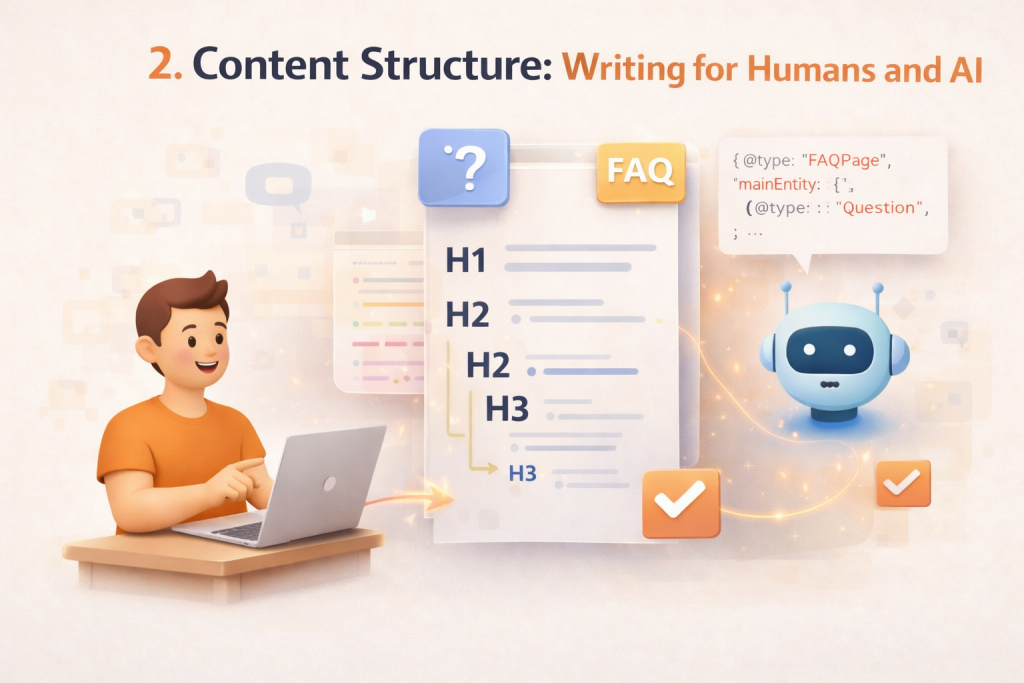
It seems obvious, but most people don’t realise this: AI systems don’t read the way humans do.
What they do is parse structure: they look for clear headings, logical hierarchy, and concise, direct answers. A wall of brilliant but unstructured text will be skipped entirely, no matter how good the information is. (RIP James Joyce, and — controversial opinion incoming — good riddance).
Every page on your site should answer an explicit question, use a logical heading structure, and signal its relevance through schema markup where appropriate.
Who Does What: Content Teams vs SEO Teams
Getting content structure right is a shared responsibility — but each team owns a distinct layer. Here’s how to split it cleanly.
Content Team’s Responsibility
- Write question-first: Every page should have one clear purpose. If the team can’t answer “what question does this page answer?” before writing, the page isn’t ready.
- Use plain, descriptive headings: No clever or vague section titles. H1, H2, and H3 should describe exactly what’s in the section, so both readers and AI can parse it instantly.
- Lead with the answer: State the key point upfront, then expand. AI pulls the first clear answer it finds; burying it in paragraph three means it won’t get cited.
- Structure content logically: Introduction → key point → supporting detail. The flow should be obvious without needing to read every word.
SEO Team’s Responsibility
- Implement schema markup: Add JSON-LD structured data (FAQ schema, Article schema, HowTo schema) so that AI and search engines understand the type of content on each page. Content teams don’t need to write this, but they should flag when a page type changes.
- Audit the heading hierarchy across the site: Ensure H1–H3 structures are consistent across all pages, not just individual articles. A site-wide crawl catches gaps that content teams can’t see page by page.
- Define the brief before content is written: SEO should specify the target question each page answers before writing begins, so that structure is built in from the start, not retrofitted after.
- Run structured data testing: Validate schema markup using Google’s Rich Results Test after every major content update to ensure AI systems are reading the page correctly.
Where They Overlap
The briefing stage is where both teams must align. SEO defines the question each page answers before content is written. That way, structure is built in from day one and not patched in after publishing.
Neither team works in isolation here. The best results come when SEO defines the structure in the brief and the content team writes to that structure, with both reviewing the page before anything goes live.
| Do This | Avoid This |
| Use a clear H1 → H2 → H3 heading hierarchy throughout | Clickbait headlines like “10 Mind-Blowing Secrets That Will Change Your Business Forever!” — and it turns out to be a checklist about updating meta tags. |
| Implement Schema Markup and JSON-LD structured data | An article titled “What is Digital Transformation?” that spends four paragraphs on the Industrial Revolution before defining the term. |
| Add FAQ sections that answer the questions your audience is actually asking | Writing about AI strategy without answering basic questions like “What is AEO?” or “How is it different from SEO?” Focus on what the audience wants to know and how they can realistically achieve that. |
| Open each section with a direct, concise answer and then expand | Dramatic, vague introductions that delay the actual answer for suspense. This isn’t Netflix. |
| Include bullet point summaries on longer pages | Long blocks of text with no visual or structural breaks. Holy Wall of Text, Batman! |

More than 60% of global web traffic comes from mobile devices, and that number keeps climbing. When you have the internet in your hands, who wants to go through the arduous task of flipping up a laptop screen and opening yet another browser tab?
Despite this, many businesses still treat mobile as an afterthought, polishing it after the desktop site is finished. This thinking is not only outdated, but it’s also actively damaging.
Google indexes the mobile version of your site first. Google also doesn’t want your customers to waste energy flipping up screens and moving cursors. Google owns almost the entire internet at this point (this is not a statistic, but have you ever heard anyone say, “Oh, I’ll just Bing it?”).
If your mobile experience is poor, your entire website pays the ranking penalty.
| Do this | Avoid this |
| Start every design from the smallest screen and scale up | Designing desktop-first and compressing down later |
| Use fluid, responsive layout frameworks | Tiny fonts and cramped navigation on mobile screens |
| Ensure tap targets and buttons are large enough to use comfortably | Skipping real device testing before launch |
| Test on real devices, not just browser emulators |
Think of technical SEO as the foundation of your website. Users may never notice crawl errors, duplicate pages, or a broken sitemap, but search engines and AI bots absolutely do. Great content built on a weak technical foundation will always underperform its potential.
| Do This | Avoid This |
| Submit and regularly maintain an XML sitemap | Ignoring 404 errors and broken links |
| Configure your robots.txt file correctly so the right pages get indexed | Allowing duplicate page content to exist without canonical tags |
| Build a deliberate internal linking structure across your site | Never checking Google Search Console for crawl issues |
| Use clean, descriptive, human-readable URL structures | |
| Secure your entire site with HTTPS |

AI engines are specifically trained to surface trustworthy, expert information. Google’s E-E-A-T framework, which stands for Experience, Expertise, Authoritativeness, and Trustworthiness, has never mattered more.
Your content isn’t just competing for clicks anymore. It’s competing to be cited inside AI-generated answers seen by thousands of people who may never visit your site directly.
Thin content actively signals to search engines that your site isn’t a credible source worth referencing. To quote The Help (2011), “it goes in the pile — you do not want it in the pile.”
| Do this | Avoid this |
| Publish original, genuinely expert-level insights instead of rephrased common knowledge | Publishing content just to fill a posting calendar |
| Back your claims with real data, case studies, and examples | Keyword stuffing instead of providing genuine value |
| Update evergreen content regularly because stale pages lose authority over time | Letting high-traffic pages become outdated |
| Credit credible,reputable external sources where relevant to build trust signals |
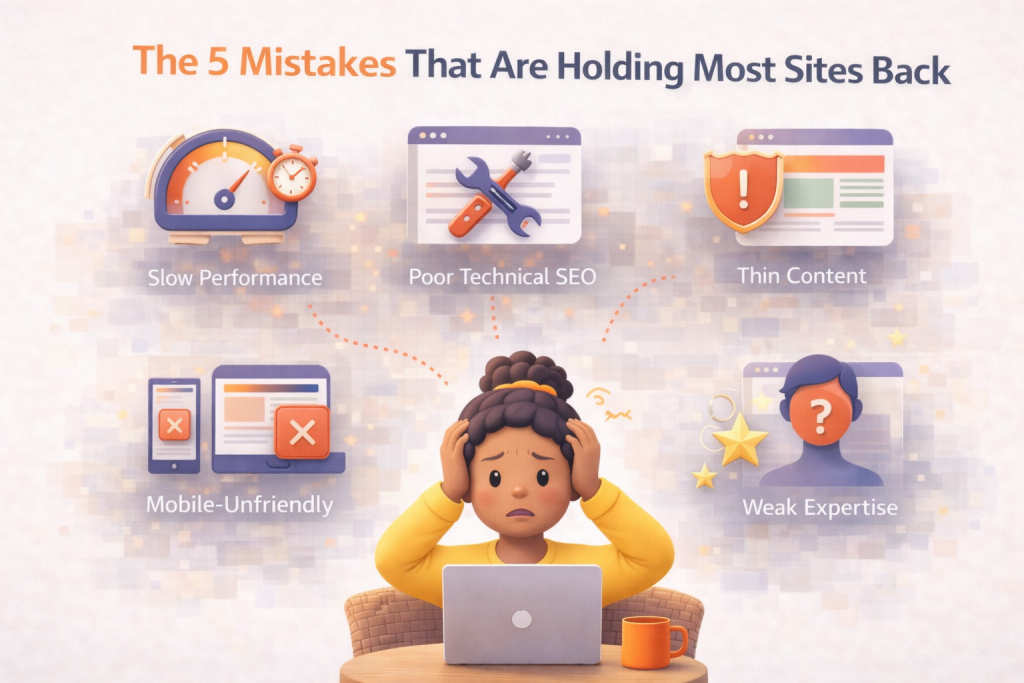
Even well-resourced teams fall into the same traps. Before your next website project, make sure you’re not making these:
| The Mistake | What To Do Instead |
| Treating SEO as an afterthought. SEO built into the architecture from day one consistently outperforms SEO retrofitted after launch. | Build SEO requirements into the project brief before design or development begins. Make technical SEO a launch checklist item, not a post-launch fix. |
| Ignoring AI optimisation entirely. Generative search is the fastest-growing discovery channel. If your content isn’t structured for it, you’re invisible where it matters most. | Audit your top pages for AIO readiness. Add schema markup, FAQ sections, and direct answer-first formatting so AI engines can cite your content. |
| Prioritizing design over speed. A visually stunning website that loads in six seconds will be abandoned. Speed is a design decision. | Set a Core Web Vitals target before design begins. Run Lighthouse audits at every stage. Treat load time as a design constraint, not an afterthought. |
| Running an outdated CMS. Old platforms create security vulnerabilities, slow your site down, and limit your technical SEO capabilities at the most fundamental level. | Audit your CMS annually. If it’s blocking schema support, slowing page load, or creating plugin debt, migrate to a modern platform that supports your SEO and AIO goals. |
| Not tracking performance data. Without measurement, you’re guessing. And guessing is expensive when your website is your primary business asset. | Set up Google Search Console, GA4, and Core Web Vitals monitoring before launch. Review performance monthly and tie content and SEO decisions to real data. |
The Bottom Line
The AIO, GEO, and AEO age isn’t coming; it’s already here. Businesses that adapt early will capture visibility that their slower competitors simply won’t. The checklist above isn’t complicated, but it requires intention, expertise, and consistent execution.
Speed, structure, mobile-first design, technical integrity, and authoritative content. These five pillars aren’t independent tactics. They reinforce each other. Get all five right, and you don’t just build a website — you build a compounding digital asset that grows in value over time and performs well across search engines, AI platforms, and answer engines.
In the AEO era, where users increasingly rely on AI assistants and direct answers instead of traditional search results, content must be structured clearly, backed by expertise, and optimised ffor machines to understand and cite. Businesses that prioritize AIO (AI Optimisation), GEO (Generative Engine Optimisation), and AEO (Answer Engine Optimisation) will be the ones that remain visible in an AI-first discovery ecosystem.
Trivone has spent over 25 years helping India’s leading brands tell better stories, create smarter content, and build stronger digital presence. From Microsoft and IBM to Digital India and Tata, we’ve delivered 300+ content projects across the verticals that matter most. We don’t just understand the AIO, GEO, and AEO era: we’ve been building towards it long before these terms became industry buzzwords.